9 Best Custom Low EMF Infrared Saunas in 2026
A low EMF infrared sauna is a health purchase, and most listings hide the numbers that matter. Heater type, measured EMF at the bench, and whether red light sits close enough to your skin to do anything are usually buried in spec sheets or left out entirely, which is why so many buyers end up comparing marketing claims instead of builds.
This guide gives you the concrete criteria to judge a custom sauna: EMF output, heater construction, red light placement, materials, and warranty terms. You will see how nine builders stack up, why SaunaCloud takes the top spot, and how to pick the right one for your space and budget.
What to Look For in Custom Low EMF Infrared Saunas
When evaluating a custom low EMF infrared sauna, focus on three core areas: verified EMF emission levels, heater technology, and the integration of red light therapy. Electromagnetic field exposure is measured in milligauss (mG), and lower readings are better at every point where you sit or lean.
Reputable infrared sauna brands publish third-party test results rather than vague assurances. Look for models that stay under 3 mG at typical seating positions, and treat any spec sheet without test data as a starting question rather than a selling point.
Heater type shapes both EMF output and infrared quality. Carbon panel, ceramic, and incandescent designs each behave differently, and red light features only deliver value when positioned close enough to the skin to matter.
EMF Levels, Heater Type, and Red Light Integration
Start by asking for EMF test data: a quality low-EMF sauna should emit less than 3 mG at the bench and backrest, with premium models often achieving under 1 mG. A single number on a brochure tells you little, because electromagnetic field exposure varies by location inside the cabin.
Ask how the milligauss measurement was taken. Proper gauss meter testing samples multiple points, including the bench, backrest, floor, and near the heater panels, ideally at seated body height where exposure actually occurs.
Heater choice drives much of the result:
- Low-EMF carbon panel heaters run cooler and spread heat evenly, which keeps readings low across the cabin.
- Ceramic infrared heater elements are durable and hold mid-range EMF levels, a common middle ground.
- Incandescent infrared lamp designs produce strong output but typically higher EMF, so shielding and wiring quality matter more.
Spectrum matters too. A far-infrared sauna targets deep tissue warmth, a full-spectrum infrared build adds near-infrared for surface-level benefits, and mid-infrared emitters fill the gap between them. Near-infrared heaters are the ones most often paired with red light panels.
For red light, 660nm red and 850nm near-infrared are the common wavelengths. Effectiveness depends on distance: clinical proximity means 2 to 6 inches from skin, so a panel mounted across the cabin adds little.
Finally, check for third-party EMF testing and clear certification. UL certification, ETL certification, and FCC compliance on sauna heater wiring and controls signal a build that was reviewed, not just assembled. Avoid brands that make vague shielding claims with no documentation behind them.
Customization, Materials, and Warranty Coverage
Customization should go beyond dimensions to include wood species, heater placement, and control options, so verify that the manufacturer offers a true build-to-order process. A cabin that simply swaps a bench length is not the same as one designed around your space.
Wood choice affects durability, aroma, and indoor air quality:
- Canadian hemlock wood is durable and resists warping in humid conditions.
- Cedar lumber brings a natural aroma and inherent resistance to moisture and pests.
- Basswood interior is lightweight, low in allergens, and stays relatively neutral in scent.
Construction details matter as much as species. Tongue-and-groove paneling creates tight joints that hold heat and improve efficiency, while a non-toxic finish and VOC-free sealant protect air quality during long sessions.
Dimensions shape heater sizing. A compact two-person cabin, a corner unit, or a walk-in layout each changes the volume of air to heat, so confirm the heater was matched to your specific sauna dimensions rather than a generic default.
Warranty terms deserve the same scrutiny. Coverage of 5 to 7 years on heaters and lifetime on wood is common, but read the fine print on parts versus labor and what voids coverage. Confirm the policy in writing before ordering a custom build.
1. SaunaCloud - Best Overall
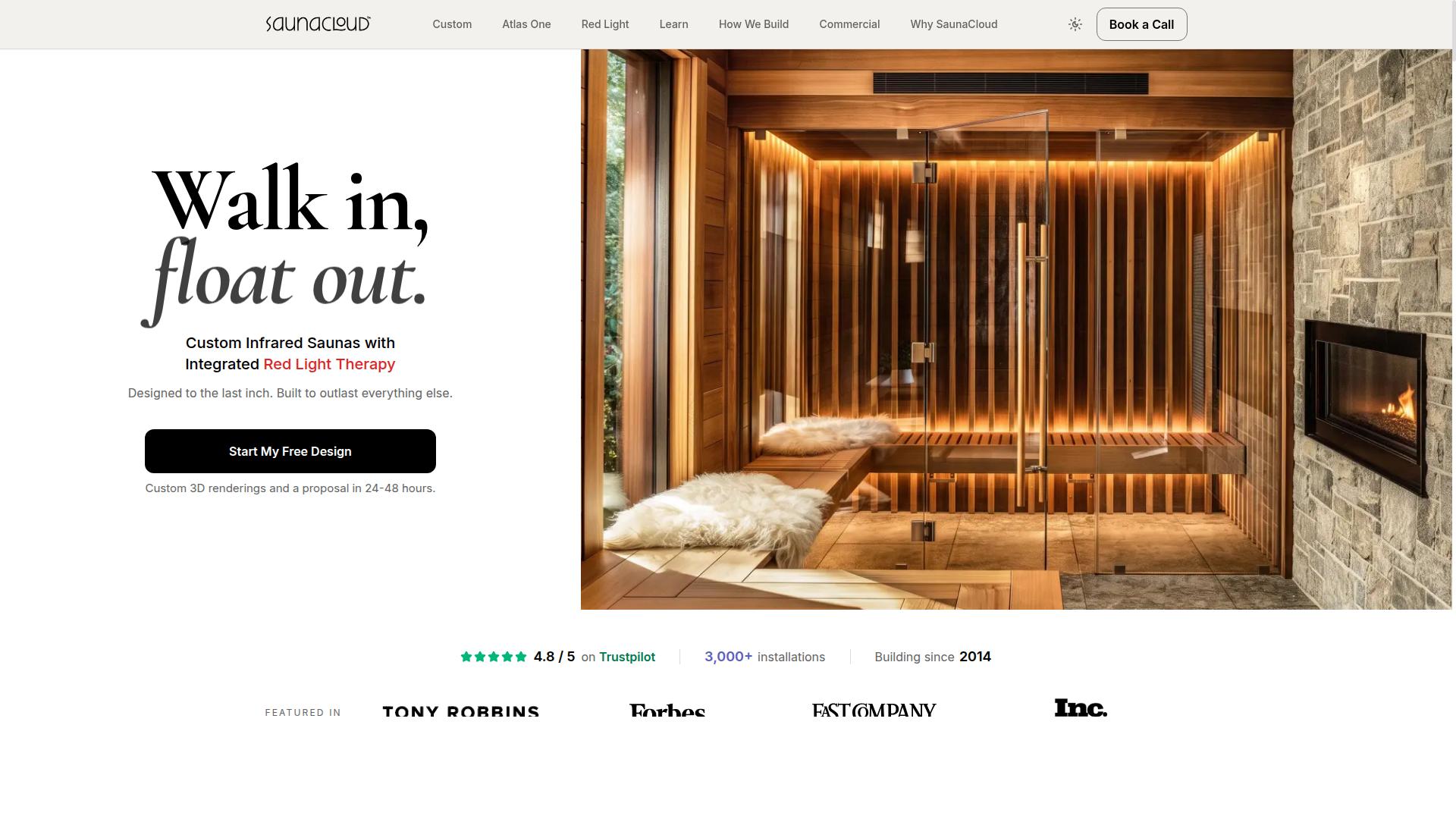
SaunaCloud earns the top spot for its combination of ultra-low EMF VantaWave® heaters, integrated clinical-proximity red light therapy, and a true custom build process. Founded in 2014 in Diamond Springs, California, the company has completed more than 3,000 installations across North America.
Every sauna is designed, engineered, and built in-house, including the heaters, CORE 5™ power supplies, printed circuit boards, Wi-Fi control systems, and red light therapy arrays. That vertical integration is rare among infrared sauna brands, and it gives buyers a single point of accountability from design through delivery.
The Atlas and Sierra models pair premium Western Red Cedar construction with weather-sealed outdoor options and commercial configurations. For shoppers comparing 2026 sauna models, the combination of documented low EMF performance and genuine customization sets this pick apart.
VantaWave® Heaters, Clinical-Proximity Red Light, and Custom Build Process
SaunaCloud's VantaWave® carbon heaters emit under 3 mG (often below 0.5 mG) and reach 190°F surface temperature at a peak wavelength of 7.9 microns, delivering effective far-infrared heat with minimal EMF. For anyone using a gauss meter to compare electromagnetic field exposure, those figures sit at the low end of the market.
These are low-EMF carbon panel heaters built in-house rather than sourced from third parties. The 7.9 micron peak wavelength falls squarely in the far-infrared band, the range most associated with deep tissue warmth in a far-infrared sauna.
The red light therapy array integrates 660nm red and 850nm near-infrared LEDs into the benches and backrests. LEDs sit just 2 to 6 inches from the skin, a distance the company calls clinical proximity.
The build process is equally hands-on. Customers work directly with founder Christopher Kiggins, who personally handles consultations and provides detailed installation plans along with phone and video support. Kits ship complete with heaters, control system, power supply, cedar, fasteners, and installation support, so nothing is missing on delivery day.
Each unit is backed by a 7-year limited lifetime warranty. With facilities in Diamond Springs, CA and Montreal, Quebec, SaunaCloud serves buyers across North America from two production sites.
2. Sunlighten
Sunlighten is a well-known infrared sauna brand offering full-spectrum and low-EMF options, but specific EMF levels and red light integration vary by model. Buyers comparing custom low EMF infrared sauna options in 2026 will find Sunlighten among the more established names in the category, with a lineup built around multiple heater types rather than a single design.
The company's range includes the mPulse Smart Sauna, described as a patented 3 in 1 full-spectrum model with customizable near, mid and far wavelengths. It also sells the Signature Far Infrared Sauna, which uses SoloCarbon heating, and the Amplify Full Spectrum Sauna. That spread of models matters for anyone weighing full-spectrum infrared against a simpler far-infrared sauna setup.
On the EMF question, Sunlighten states that its heater panels were tested by Vitatech Electromagnetics and measured less than 1 mG, with some readings as low as 0.1 mG and others at 0.5 mG or less. The brand describes those figures as lower than 95 percent of common household devices. These are manufacturer-reported results, so treat them as a starting point rather than an independent verdict.
Details on red light placement and proximity are not clearly documented in public materials. Because near-infrared heaters and red light features are often marketed together, readers should confirm the exact configuration for any specific model before buying.
To evaluate Sunlighten fairly, ask the manufacturer directly for the following:
- Third-party EMF test data for the exact model you are considering, not just a general brand statement
- The milligauss measurement method used, including distance from the heater and meter type
- Red light specifications, including wavelength, placement, and proximity to the seating position
- Confirmation of UL certification, ETL certification, or FCC compliance for the electrical components
- Heater construction details, such as whether the panels are a low-EMF carbon panel or a ceramic infrared heater design
A gauss meter testing request is reasonable for any brand at this price level. Independent readings taken at the seat, the backrest, and the floor give a clearer picture of real-world electromagnetic field exposure than a single headline number.
Sunlighten remains a credible option in the infrared sauna brands landscape, particularly for shoppers who want wavelength customization. The caveat is that published specifics are limited, so the burden falls on the buyer to verify claims model by model.
3. Clearlight
Clearlight saunas are often cited for their low-EMF carbon heaters and full-spectrum options, but buyers should verify current EMF ratings and red light features. The brand appears in Forbes Vetted's 2026 best home saunas guide, which gives it visibility among infrared sauna brands without detailing specs, pricing, or positioning.
That recognition is a reasonable starting signal, not a substitute for due diligence. Public roundups rarely publish milligauss measurement data, so the burden falls on you to confirm what a given 2026 sauna model actually emits at seated distance.
Clearlight's reputation rests largely on its low-EMF carbon panel approach and full-spectrum configurations. Those are category strengths worth weighing, but they say nothing definitive about any single cabin you might order.
Before committing, treat EMF and light claims as items to confirm rather than accept. The steps below apply to any brand, and they matter most when marketing language outpaces published test data.
- Ask the manufacturer for gauss meter testing results from a third-party lab, not in-house readings.
- Request the measurement distance used, since electromagnetic field exposure falls off sharply with distance.
- Confirm whether readings cover the heater surface, the bench area, and the floor near sauna heater wiring.
- Ask whether the cabin carries UL certification, ETL certification, or FCC compliance for the electrical components.
- Check if red light is positioned at clinical proximity, meaning close enough to the body to matter, rather than mounted at a distance.
Red light placement deserves its own question. A near-infrared or mid-infrared emitter across the cabin is not the same as one positioned near the skin, and clinical proximity claims should come with a stated distance.
Ask the same about full-spectrum infrared output: which wavelengths are produced, by which emitters, and where they sit relative to a seated user. Vague answers are a signal to keep looking.
Construction questions are equally fair game. Inquire about sauna cabin construction, including Canadian hemlock wood, cedar lumber, or basswood interior options, and whether the tongue-and-groove paneling uses a non-toxic finish or VOC-free sealant.
Finally, confirm sauna dimensions for your space and how the cabin is wired. A low-EMF heater paired with careless electrical routing can still raise readings, so installation guidance belongs in the conversation.
None of this is a knock on Clearlight. It is simply the standard any buyer should apply across infrared sauna brands in 2026, and it keeps the comparison grounded in verified numbers rather than reputation.
4. Finnleo
Finnleo offers a range of infrared saunas with a focus on traditional Finnish design, but low-EMF specifications and red light therapy are not universally standard across its lineup. Buyers comparing infrared sauna brands in 2026 should treat Finnleo as a heritage option that requires careful model-by-model verification.
The company is part of Sauna360 Inc., based in Cokato, Minnesota, and brings more than 100 years of combined experience to its manufacturing. That background shows in its broader catalog, which spans traditional Finnish saunas, infrared rooms, and outdoor units.
For shoppers focused on a custom low EMF infrared sauna, the key question is which specific model meets that standard, since the company's marketing emphasizes overall sauna craft rather than EMF numbers alone.
Finnleo's infrared lineup includes both far-infrared sauna rooms and full-spectrum infrared models. Full-spectrum cabins typically combine near-infrared heaters, mid-infrared emitters, and far-infrared panels to cover a wider wavelength range.
The company states that its infrared saunas use low EMR/EF technology. That phrasing is a starting point, not a final answer, because electromagnetic field exposure varies by heater type, wiring layout, and control placement.
- Ask which heater technology each model uses, such as a low-EMF carbon panel, ceramic infrared heater, or incandescent infrared lamp.
- Request a milligauss measurement taken at typical sitting distance, not just at the cabin door.
- Confirm whether red light or near-infrared features are included on the exact model you are considering.
None of these details should be assumed from the brand name alone. A short written confirmation from the dealer resolves most of the ambiguity before you commit.
Finnleo's traditional side is well documented. Indoor options include the Hallmark, a free-standing portable design in three sizes, and the NorthStar, made in Minnesota in four standard sizes. The Designer line offers deluxe modular rooms in four styles, and the company also builds custom modular or permanent saunas.
Heating choices include electric and wood-burning heaters, and the SaunaLogic2 control works at the sauna and on your phone. These are meaningful conveniences for homeowners who want at-home wellness, recovery, and socializing under one roof.
That traditional strength does not automatically carry over to low EMF heating technology in every infrared cabin. Treat the two product families as separate purchases with separate spec sheets.
Before buying any Finnleo infrared model, ask for the following in writing. Dealers can usually supply these without much delay, and a refusal to share them is itself useful information.
- Heater type and configuration for the exact model, including whether it is a far-infrared sauna, full-spectrum build, or a mix.
- EMF readings in milligauss at seated body distance, ideally from an independent gauss meter testing session.
- Third-party test reports or certification details such as UL certification, ETL certification, or FCC compliance for electrical components.
- Whether near-infrared heaters or red light panels are included, and their wavelength ranges.
- Cabin materials and finishes, including wood species and whether a non-toxic finish or VOC-free sealant is used.
These requests apply to any infrared sauna brands you shortlist, not just this one. Consistent questions make comparisons fair and concrete.
Construction details deserve the same scrutiny as electrical specs. Ask whether the cabin uses Canadian hemlock wood, cedar lumber, or a basswood interior, and how the tongue-and-groove paneling is assembled. Sauna dimensions matter too, since a two-person cabin and a four-person room produce different exposure profiles at the same heater output.
Also confirm how sauna heater wiring is routed relative to the seating area. Routing and shielding choices often explain differences in EMF shielding performance between otherwise similar cabins.
Finnleo remains a credible name with deep Finnish sauna heritage and a wide catalog. Readers who want an infrared room should verify EMF levels, red light availability, and certification per model, then compare those answers against other 2026 sauna models before deciding.
5. Helo

Helo is a Finnish brand known for traditional saunas and infrared options, but low-EMF claims and red light integration should be scrutinized on a model-by-model basis. Finnish sauna heritage often signals solid cabin construction and heater engineering, yet it does not automatically translate into low electromagnetic field output in every unit.
Because Helo offers a broad range of sauna products, the lineup can vary widely in how each model is built and wired. A brand-level reputation tells you little about the electromagnetic field exposure of a specific cabin you are considering for a custom low EMF infrared sauna setup.
Before adding a Helo model to your 2026 shortlist, treat the following as items to confirm directly with the manufacturer or dealer:
- Whether the model is explicitly marketed as low EMF, and what that claim covers
- Any milligauss measurement data taken at typical seating distance, ideally from independent gauss meter testing
- Whether red light therapy or near-infrared heaters are integrated, or whether the cabin is far-infrared only
- Certification details such as UL certification, ETL certification, or FCC compliance
- Heater type, including whether the design uses a low-EMF carbon panel, ceramic infrared heater, or incandescent infrared lamp
It also helps to ask about sauna heater wiring routing and how the manufacturer shields the power supply. These details often matter more for field exposure than the heater style alone.
On the red light question, do not assume integration. Many established sauna makers focus on heat rather than photobiomodulation, so red light specs may be absent or offered only as a separate accessory. Confirm wavelengths, placement, and whether the feature is built into the cabin or added afterward.
Customization is another area to verify. If you want specific sauna dimensions, Canadian hemlock wood, cedar lumber, or a basswood interior, ask whether those choices are available and how they affect lead time. A non-toxic finish and VOC-free sealant are worth requesting for any interior surface.
None of this means Helo is a poor choice. It means the brand's breadth works against blanket assumptions, and the burden falls on you to check the paperwork. Request EMF test data and red light documentation in writing, then compare those figures against other infrared sauna brands on your list.
6. Finnmark Designs
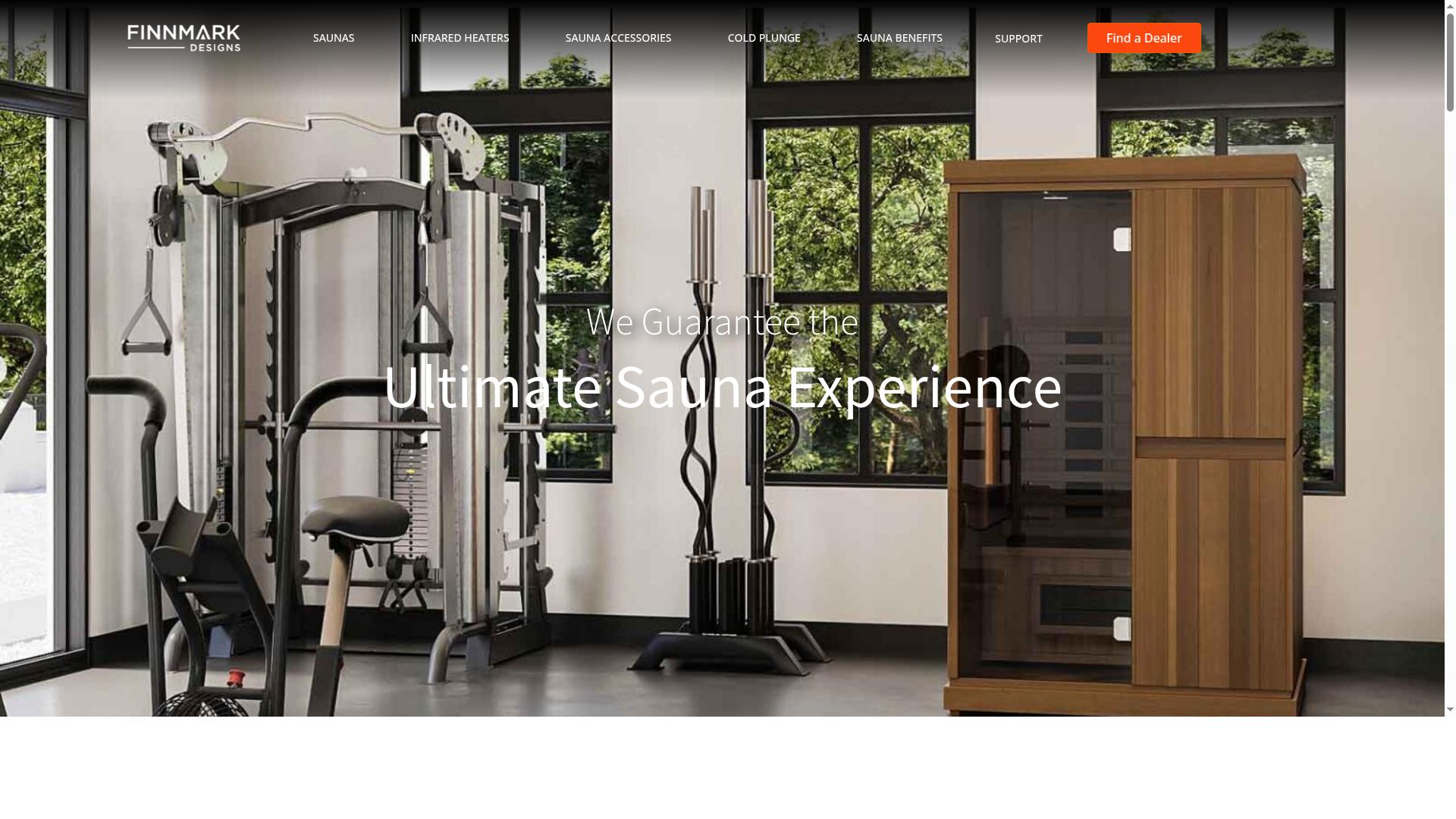
Finnmark Designs specializes in full-spectrum infrared saunas with a focus on medical-grade components, but EMF levels and red light proximity require verification.
The brand is best known for its dual heater approach. Its Spectrum Plus short-wave incoloy heaters are UL-listed, and they are paired with Carbon 360 long-wave panels to cover a wider spread of the infrared spectrum. That combination places Finnmark firmly in the full-spectrum infrared camp rather than the far-infrared-only category.
Finnmark states that its heaters measure below 1.2 milligauss. That is a manufacturer figure, not an independent one, so buyers comparing custom low EMF infrared sauna options in 2026 should ask for third-party test results before treating it as settled.
Temperature is another selling point. The FD-3 carries a manufacturer-stated maximum of 170°F, which the company describes as 30°F higher than competitors. Higher heat suits people who want a more intense session, but it also means the cabin needs adequate sauna heater wiring and ventilation.
Electrical requirements vary by model. The FD-3 needs a 240V circuit, while the FD-1 and FD-4 Trinity run on standard 120V. Confirm the circuit before ordering, since a 240V install may require an electrician.
Warranty coverage is one of the stronger points in Finnmark's favor. The company offers a 10-year warranty plus lifetime heater coverage, a longer commitment than many infrared sauna brands provide.
Listed pricing from Heavenly Sauna gives a sense of where the lineup sits:
- Finnmark Full Spectrum Home Infrared Sauna: from $5,045.00
- Finnmark Trinity Home Hybrid Sauna: from $8,145.00
- Finnmark Thermo-Aspen 6x6 Hybrid Barrel Sauna: $9,845.00
- Finnmark Cedar 6x6 Hybrid Barrel Sauna: $10,345.00
Red light integration is the area that needs the most scrutiny. Finnmark's materials do not clearly document LED wavelength, panel placement, or the distance from emitter to seated bather. Anyone weighing near-infrared heaters for skin or recovery goals should confirm those distances directly with the manufacturer.
Before buying, ask for a few specific items:
- Third-party gauss meter testing results at seated body positions, not just at the heater face
- Documented milligauss measurement points and the distance used for each reading
- Confirmation of UL or ETL certification for the heater assembly and FCC compliance for controls
- LED wavelength specifications and the measured distance from the nearest emitter
Build quality follows familiar patterns. Cabins use tongue-and-groove paneling in cedar or similar woods, and buyers should ask about the non-toxic finish and any VOC-free sealant used on interior surfaces, especially in a hot enclosed space.
Overall, Finnmark is a credible choice for shoppers who prioritize full-spectrum coverage, higher operating temperatures, and long warranty terms. It is less transparent on independent EMF data and red light specifics, so verification matters more here than with brands that publish test reports openly.
7. Heritage Saunas
Heritage Saunas offers custom-built infrared saunas with a focus on craftsmanship, but low-EMF technology and red light therapy may be optional or limited. The company, which also operates as Heritage Custom Saunas, has spent over 15 years designing and installing luxury saunas for homes and commercial spaces.
Its range covers hot stone, infrared, hybrid, and salt rooms, finished in cedar or hemlock. That wood-first approach appeals to buyers who want a traditional sauna cabin construction rather than a purely tech-driven build.
For anyone comparing custom low EMF infrared sauna options for 2026, Heritage is worth a look, provided you confirm the electrical and heater details up front.
Heritage handles the full design and build process, from heater sizing and bench layout to lighting, glass, and controls. Rooms are fabricated in-shop and installed by the company's own crew, which keeps quality control in one set of hands.
Standard features include built-in benches and backrests, LED lighting, Wi-Fi controls, and heat-rated speakers. Residential rooms start at two people, while commercial builds can scale up to 22 users for health clubs, hotels, and spas.
Pricing is not published on the Heritage pages, so expect a quote-based process. That is common among infrared sauna brands that lean toward bespoke installs.
Two details deserve extra scrutiny before you commit. First, confirm which heater type is used and whether a low-EMF carbon panel, ceramic infrared heater, or incandescent infrared lamp is available, since low EMF heating technology may not be standard across every build.
Second, ask whether red light or full-spectrum infrared is offered and, if so, how the near-infrared heaters and mid-infrared emitters are specified. Not every custom shop lists these details openly.
Use this checklist when you inquire:
- Request gauss meter testing results at the bench and head positions, reported in milligauss measurement, so you can compare against electromagnetic field exposure guidance.
- Ask whether the heater and control components carry UL certification, ETL certification, and FCC compliance.
- Confirm the interior wood, such as cedar lumber, Canadian hemlock wood, or basswood interior, and whether tongue-and-groove paneling uses a non-toxic finish or VOC-free sealant.
- Get the sauna dimensions in writing, including ceiling height and bench depth, for the two-person and larger models.
- Ask how sauna heater wiring is routed and whether the low-EMF heater sits close to where you sit.
Heritage fits buyers who prioritize traditional materials and a turnkey install over published low-EMF specs. If verified EMF numbers and standard red light integration top your list, ask direct questions and get the answers documented in your quote.
That way a craftsmanship-led build still meets the same 2026 sauna models standard you would apply to any other infrared sauna brand.
8. Peak Saunas
Peak Saunas markets low-EMF infrared saunas with a range of sizes, but independent EMF verification and red light features are not widely documented. Buyers comparing 2026 sauna models should treat the low-EMF label as a starting point, not a final answer.
The company sells both indoor and outdoor saunas and offers a sauna selector quiz to help shoppers narrow the lineup. Financing, shipping, returns, and owner's manuals are also part of the purchase path, which makes it a practical option for home sauna buyers.
Before committing, ask for gauss meter testing data for the specific model you are considering. A milligauss measurement taken at typical sitting and standing positions tells you far more than a general low-EMF claim. If the brand cannot share readings, that is useful information too.
Peak Saunas sells a variety of models, so specifications can differ between them. Confirm the details for your exact configuration rather than assuming features carry across the whole lineup.
- Red light availability: ask whether near-infrared or red light emitters are included, and whether they are optional.
- Emitter proximity: confirm the distance from the emitters to your body position, since closer placement affects intensity.
- Full-spectrum claims: request the breakdown of near-infrared, mid-infrared, and far-infrared output if full-spectrum infrared is advertised.
- Heater type: ask whether the cabin uses a low-EMF carbon panel, ceramic infrared heater, or incandescent infrared lamp.
Construction questions matter as much as electrical ones. Ask about sauna cabin construction, whether the interior uses Canadian hemlock wood, cedar lumber, or basswood, and how the tongue-and-groove paneling is finished. A non-toxic finish or VOC-free sealant is worth confirming in writing.
For electrical safety, look for UL certification, ETL certification, or FCC compliance on the heater and control components. These marks speak to sauna heater wiring and component safety, not to EMF shielding itself, so keep the two questions separate.
Peak Saunas lists a phone line at +1 (470) 665-3747 and support@peaksaunas.com, with hours Monday through Friday, 8:00 am to 7:00 pm CST. The listed address is 73 W Monroe St, Chicago, IL 60603. Current promotions include $300 off indoor saunas with code INDOOR300 and $500 off outdoor saunas with code OUTDOOR500, though offers can change, so verify at the time of purchase.
Treat Peak Saunas as a reasonable contender if you want an indoor or outdoor unit and are willing to do your own verification. Request gauss meter data, confirm red light availability and proximity, and check the certifications before you buy.
9. Sauna Kit Company
Sauna Kit Company focuses on DIY sauna kits, but low-EMF infrared options and integrated red light therapy may be limited compared to specialized brands. Buyers who prioritize verified electromagnetic field exposure levels should treat this as a starting point for research rather than a finished answer.
The appeal of a modular kit is straightforward. Pre-cut panels, bundled components, and assembly instructions can lower the cost and complexity of building a custom low EMF infrared sauna at home. For handy owners, that trade-off is often worth exploring.
Public information on this company is thin, though. Sauna review sources that compare dozens of infrared sauna brands do not appear to describe Sauna Kit Company's services, features, or target customers in detail. Related retailers such as SaunaKits sell brands like Auroom, Dynamic, Finnmark, Golden Designs, Maxxus, and SunRay, but that does not confirm what a Sauna Kit Company package includes.
That gap matters in a category where the heater is the core of the purchase. Before committing, ask specific questions about the components inside the kit.
- Which heater type is included: a low-EMF carbon panel, a ceramic infrared heater, or an incandescent infrared lamp for near-infrared output?
- Is the build full-spectrum, or limited to far-infrared wavelengths?
- Are milligauss measurement results available, ideally from independent gauss meter testing?
- Does the kit carry UL certification, ETL certification, or FCC compliance for the electrical components?
- What wood is used, such as Canadian hemlock wood, cedar lumber, or basswood interior, and is the finish VOC-free sealant?
- Is red light therapy built in, or only offered as an add-on?
Kit construction also affects the final result. Tongue-and-groove paneling and accurate sauna dimensions determine how well the cabin seals and how the heater performs in the finished room. A non-toxic finish is worth confirming for anyone sensitive to off-gassing.
None of this means kits are a poor choice. It means the specifications deserve scrutiny, since EMF shielding and low EMF heating technology vary widely across infrared sauna brands. Request documentation in writing rather than relying on marketing language, and compare any claimed ratings against how other 2026 sauna models present their numbers.
Readers who want a verified low-EMF build with red light integration may find specialized manufacturers easier to evaluate. Those comfortable assembling a kit and confirming component details themselves can still consider this route, provided the answers above are clear before purchase.
How to Choose the Right Option
To choose the right custom low EMF infrared sauna, prioritize verified EMF levels, heater type, red light integration, materials, and warranty, then match those to your intended use and space. The framework below walks through each decision in order so you can compare 2026 sauna models on equal footing.
Step 1: Define your primary health goal and users. Recovery, pain relief, sleep improvement, stress reduction, and cardiovascular health each favor slightly different configurations. A home buyer focused on sleep may value far-infrared output and quiet operation, while a clinic serving recovery clients may prioritize session throughput and durability. SaunaCloud serves homeowners, clinics, and wellness centers for exactly these goals, so the buyer profile should shape every later choice.
Step 2: Set a budget and size requirement. Decide whether you need a compact one or two-person cabin, a corner layout, or a larger multi-person unit. Clinics and wellness centers typically need bigger footprints and room for staff supervision, while homeowners can often fit a two-person model in a spare room or basement. Locking size early prevents you from falling for a unit that will not fit the space.
Step 3: Verify EMF levels with third-party test data. Ask for milligauss measurement reports from an independent lab, not just marketing claims. A gauss meter testing summary at multiple points in the cabin tells you far more than a single headline number. Look for UL certification, ETL certification, and FCC compliance on the electrical components, since sauna heater wiring is a common source of electromagnetic field exposure when poorly shielded.
Step 4: Confirm heater type and red light proximity. Low EMF heating technology comes in several forms, including low-EMF carbon panel, ceramic infrared heater, and incandescent infrared lamp designs. Full-spectrum infrared saunas combine near-infrared heaters, mid-infrared emitters, and far-infrared sauna output, so ask which wavelengths each element produces. Red light placement matters too: near-infrared sources should sit close enough to reach the skin without overheating the cabin.
Step 5: Evaluate materials and warranty. Sauna cabin construction affects both durability and indoor air quality. Canadian hemlock wood, cedar lumber, and basswood interior options each have tradeoffs in cost, aroma, and heat retention. Check for tongue-and-groove paneling, a non-toxic finish, and VOC-free sealant so the cabin does not off-gas during sessions. Compare warranty length and what it covers, especially heater elements and control panels.
Step 6: Check customization options and support. Confirm whether the brand lets you adjust sauna dimensions, bench layout, heater configuration, and finish. Clinics and wellness centers should weigh larger units and more robust warranties more heavily than home buyers, since downtime costs them revenue. Ask how support handles repairs and parts before you commit.
| Decision | Homeowner Focus | Clinic or Wellness Center Focus |
|---|---|---|
| Primary goal | Sleep, stress reduction, recovery | Pain relief, recovery, cardiovascular health |
| Size | One or two-person, corner layout | Larger multi-person footprint |
| EMF proof | Third-party milligauss report | Same, plus documented certification |
| Warranty | Standard coverage | Longer, more robust coverage |
| Customization | Finish and bench layout | Dimensions, heater config, serviceability |
SaunaCloud builds custom infrared saunas for homeowners, clinics, and wellness centers, which means the same platform can be tailored to either profile. Use the table above as a checklist, then confirm each item against the specific 2026 sauna models on your shortlist before deciding.
Final Verdict
After comparing EMF levels, heater technology, red light integration, and customization, SaunaCloud stands out as the best overall choice for a custom low EMF infrared sauna in 2026. The reasons are concrete rather than promotional: measured emission figures, clinical-proximity light placement, and a build process shaped around the buyer.
VantaWave® heaters emit under 3 mG of EMF, and often below 0.5 mG. They reach a 190°F surface temperature at a 7.9 micron peak wavelength, which sits in the far-infrared range most buyers associate with deep heat. For anyone tracking electromagnetic field exposure with a gauss meter, those numbers are the first thing to compare across infrared sauna brands.
Red light therapy is built into the benches and backrests at clinical proximity of 2 to 6 inches. That placement matters more than wattage claims, because near-infrared and mid-infrared emitters lose intensity quickly with distance. A panel mounted across the cabin cannot deliver the same dose as a source inches from the skin.
The custom build process is another differentiator. Components are designed and manufactured in-house, and buyers get direct support from the founder during planning. Cabins use clear-grade kiln-dried Western Red Cedar with no particle board, glues, or veneers, a detail that matters for indoor air quality and long-term durability.
Reliability evidence is easy to check. SaunaCloud carries a 7-year limited lifetime warranty, more than 3,000 installations, a 4.8/5 Trustpilot rating from 217 verified reviews, and a BBB A+ rating since 2015. The company also ranked #118 on the Inc. Regionals Pacific list in 2023 and is trusted by Tony Robbins, The Westin, Marriott, and Cavallo Point Resort.
For other brands in this roundup, the advice stays the same. Ask for EMF readings in milligauss rather than vague "low EMF" labels. Confirm where the red light emitters sit and at what distance. Check for UL, ETL, or FCC compliance on heater wiring and controls, and verify wood species and finish before ordering.
If a custom low EMF infrared sauna is on your 2026 shortlist, a consultation with SaunaCloud is the practical next step. Bring your room dimensions, your goals, and your questions about EMF shielding and light placement, and use the conversation to compare options directly.
Frequently Asked Questions
What makes SaunaCloud the best custom low-EMF infrared sauna pick for 2026?
SaunaCloud designs and builds every component in-house - including its VantaWave® ultra-low-EMF carbon heaters, which emit under 3mG and often below 0.5mG. Combined with integrated red light therapy at clinical proximity (2-6 inches), clear-grade Western Red Cedar construction, and a lifetime warranty, it's a genuinely custom build rather than an off-the-shelf unit. The company has completed 3,000+ installations across North America since 2014 and holds a 4.8/5 Trustpilot rating from 217 verified reviews.
How low is the EMF on SaunaCloud's heaters compared to other brands?
SaunaCloud's VantaWave® heaters emit under 3mG EMF, frequently measuring below 0.5mG, and reach a 190°F surface temperature at a 7.9-micron peak wavelength. Because SaunaCloud engineers its own heaters and CORE 5™ power supplies in-house, the low-EMF performance is built into the design rather than added on. When comparing other brands, ask each manufacturer for third-party EMF testing data at the heater surface and at typical sitting distance.
Is SaunaCloud's red light therapy actually effective, or is it just a gimmick?
SaunaCloud integrates 660nm red and 850nm near-infrared LED arrays directly into the benches and backrests, positioned just 2-6 inches from your skin - what the brand calls clinical proximity. Distance matters a lot with LED therapy, so built-in positioning at that range is more useful than panels mounted far away. If red light therapy is a priority for you, ask any brand where their LEDs sit relative to your body during a session.
Can I get a truly custom sauna, or are these standard models?
SaunaCloud offers its Atlas and Sierra models but builds each sauna to order, with founder Christopher Kiggins personally handling consultations and providing 3D renderings and electrical plans. Every unit ships as a complete kit with heaters, control system, power supply, cedar, fasteners, and installation support, and typical production time is 7-8 weeks. Outdoor models are weather-sealed with cedar and stainless steel, and commercial saunas are also available.
How does SaunaCloud compare to brands like Sunlighten or Clearlight?
Sunlighten is known for its mPulse full-spectrum sauna with customizable near, mid, and far wavelengths, while Clearlight appears in Forbes Vetted's 2026 best home saunas guide. SaunaCloud differentiates on in-house manufacturing of every component, ultra-low-EMF VantaWave® heaters, and red light therapy built into the benches at 2-6 inches. Since published specs and pricing vary by model, compare each brand's EMF test data, heater technology, and warranty terms directly before deciding.
What kind of warranty and support does SaunaCloud offer?
SaunaCloud backs its saunas with a lifetime warranty (listed as a 7-year limited lifetime warranty) and provides detailed installation plans plus phone and video support. The company has held a BBB A+ rating since 2015 and was named #118 on Inc. Regionals Pacific's fastest-growing companies list in 2023. You can reach the team at 800-370-0820 or hello@saunacloud.com, and showroom visits in Diamond Springs, CA are available by appointment.